Architecture and access
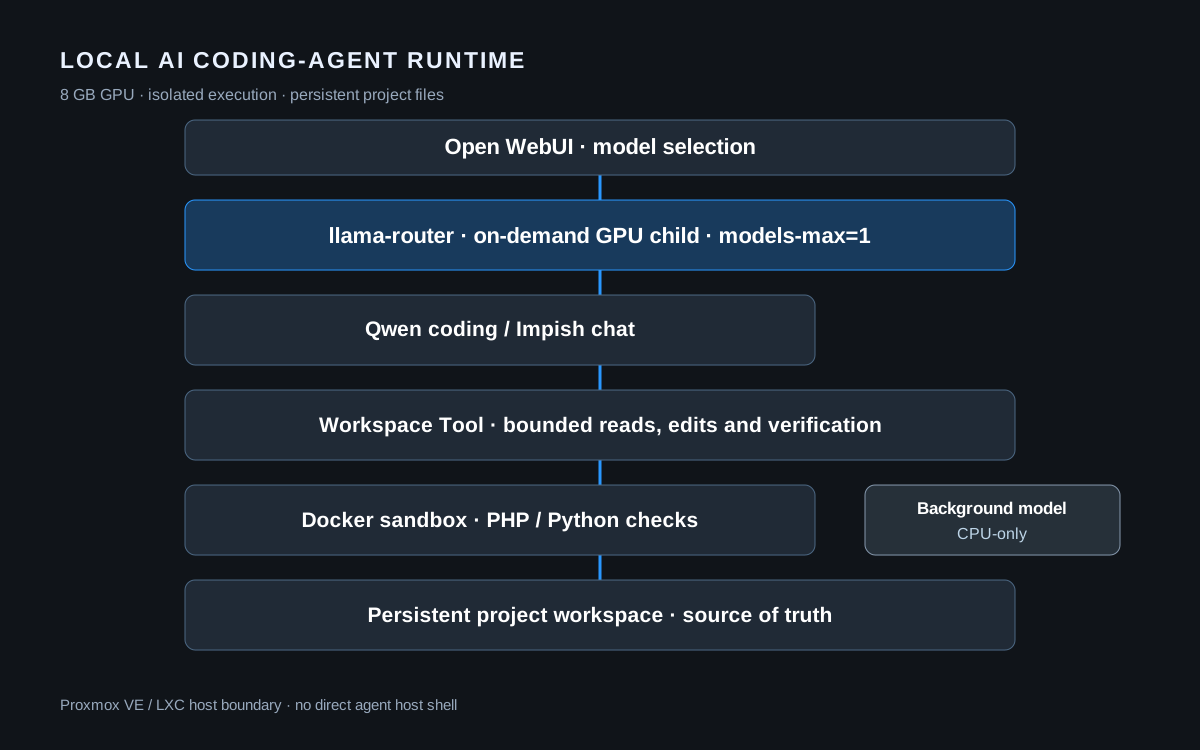
Connected Proxmox VE, LXC, Docker and a persistent workspace. The agent executes commands inside the sandbox without direct shell access to the host.
Switch the site to a light IT palette with a white background, graphite text and restrained cold-blue accents.
AI Integration · Agent Tooling · Local LLM Systems
I designed a local environment where an AI agent works with PHP and Python projects: it locates relevant code, runs commands in an isolated environment, makes bounded edits and verifies the result before completing a task.
My ownership covered architecture, tool integration, editing policy, verification, model tuning and local model routing.
Results from internal tests on 13–14 September 2026.
01 / CHALLENGE AND RESULT
I needed a local environment in which a model could work with a real repository while its actions remained bounded by a project workspace and verification tools. I connected local inference, code access, Docker sandbox execution and result verification into one PHP/Python workflow. This is an internal engineering project.
02 / MY CONTRIBUTION
Connected Proxmox VE, LXC, Docker and a persistent workspace. The agent executes commands inside the sandbox without direct shell access to the host.
Set up targeted reads and edits against the current file state; disallowed whole-file rewrites of existing files and unbounded retries.
Added PHP/Python lint, static checks and tests to the task completion flow. A second rejected edit stops further mutations.
Profiled Qwen3.6-35B-A3B across CPU/GPU and integrated llama-router: the requested model loads on GPU while a separate CPU model handles background tasks.
03 / WORKFLOW
The documented PHP scenario covers relevant repository reads, an edit, verification and finalization. A separate Python scenario tests recovery from a broken file.
Finds the relevant code and reads the current file state.
Edits a coherent range without rewriting the whole existing file.
Runs project checks: lint, static analysis and tests for PHP; compile/Ruff for Python.
Finalizes after PASS. A second rejected edit stops further changes.
04 / MEASUREMENTS
Two internal configurations tested on 13–14 September 2026. Benchmark figures and observations in coding requests are labeled separately.
| Measure | Before | Result | Test conditions |
|---|---|---|---|
| Context | 28,672 tokens | 140,800 tokens (4.91×) | Tested request; 143,872 tokens caused CUDA OOM. |
| Cold prefill | 111.05 tok/s · uBatch 128 | ~274.6–276.2 tok/s · uBatch 512 | ~275.6 tok/s on an 8,117-token cold request; 2.48× in this sweep. |
| Decode | 26.11 tok/s · no DFlash | 32.20 tok/s · DFlash n=2 | ~23% gain in a benchmark, not a per-request guarantee. |
| Coding turns | — | ~30–33 tok/s | Observed after tuning in representative coding requests. |
| Prefix cache | — | ~97–98% reuse | Representative final passes only; depends on session and model switching. |
05 / ARCHITECTURE
06 / ENGINEERING DECISIONS
Kept q8_0 K/V and a tested 140,800-token ceiling. A 143,872-token request exposed the memory boundary.
uBatch 512 improved prefill; 544/576 produced no meaningful gain. n-cpu-moe=36 uses less VRAM without a speed loss against 34.
DFlash n=2 improved decode in the recorded sweep; n=4 and n=8 performed worse.
07 / EVIDENCE
The Russian-language PDF records the architecture, configuration, measurements and internal test results from 13–14 September 2026. I can walk through sanitized task traces and verifier output in an interview.
Technical case study (PDF, RU · 220 KB) ↗For an AI feature in a commercial product, see the X-BOT support RAG FAQ. Explore X-BOT →
08 / ROLE RELEVANCE
AI/LLM integration · Agent tooling · Workflow automation · PHP/Python verification · Local inference · Model routing
Discuss a role →